5. Compositional Tracking
This notebook demonstrates the compositional tracking capabilities in TriPoD, which allows you to track multiple chemical species through gas and dust phases including sublimation and condensation processes.
TriPoDPy extends the basic dust evolution framework to include:
Multiple chemical components with distinct properties
Gas and dust phases for each component
Sublimation and condensation processes
Theory
Gas
This means under the hood TriPoDPy evolves all the gas components and sums them up to get the total gas surface density. We do this following the works of (Pavlyuchenkov and C. P. Dullemond 2007) who showed that we can decompose the evolution of gas disk into its components \(i\) as follows:
\begin{equation*} \frac{\partial \Sigma_i}{\partial t} + \frac{1}{R} \frac{\partial}{\partial R} (R \Sigma_i v_R) = \frac{3}{R} \frac{\partial}{\partial R} \left[ R \nu \Sigma \frac{\partial}{\partial R} \left( \frac{\Sigma_i}{\Sigma} \right) \right]. \end{equation*}
where the velocity is given by:
\begin{equation*} v_R = -\frac{3}{\Sigma \sqrt{R}} \frac{\partial}{\partial R} \left( \Sigma \nu \sqrt{R} \right). \end{equation*}
and the total gas surface destiy is \(\Sigma = \sum_i \Sigma_i\).
Dust
for active dust components we follow (Schneider & Bitsch 2021) i.e. the dust evolution can be described by if there are mutiple components present:
\begin{equation*} \frac{\partial \Sigma_{d,i,j}}{\partial t} + \frac{1}{r} \frac{\partial}{\partial r} \left\{ r \left[ \Sigma_{d,i,j} \cdot u_{d,j} - \frac{\partial}{\partial r} \left( \frac{\Sigma_{d,i,j}}{\Sigma_{\text{gas}}} \right) \cdot \Sigma_{\text{gas}} \nu \right] \right\} = \frac{\partial \Sigma_{d,i,j}}{\partial t}\vert_{coag} \end{equation*}
where the velocities \(u_{d,j}\) are acalcualted for the total dust and \(j\) refers to the mass bin (0 or 1). The bulk density of the total dust is given by:
\begin{equation*} \rho_s = \sum_i \Sigma_i /(\sum_i \Sigma_i/\rho_{s,i}) \end{equation*}
and the coagualtion source term for each component is defiend by:
\begin{equation*} \dot{\Sigma}_{i,0 \rightarrow 1} = \frac{\Sigma_{i,0} \Sigma_1 \sigma_{01} \Delta v_{01}}{m_1 \sqrt{2\pi(H_0^2 + H_1^2)}}, \dot{\Sigma}_{1\rightarrow 0} = \frac{\Sigma_1 \Sigma_{1,i}\,\sigma_{11}\,\Delta v_{11}}{ m_1\,2\pi H_1^{2}}\,\mathcal{F} \end{equation*}
where \(\mathcal{F}\) is the same as in section 0. this ensures all of the species exchange mass on the same timescale as the global dust.
Evaporation and Condensation
lastly we have to go over how the equilibration between the dust and gas phase works if we have a species that is active in both gas and dust. We follow the descrition outlined in (Penzlin et al. 2024) to describe the sublimation and condensatiion rates of each species.
the sublimation of a specific species \(i\) is given by: \begin{equation*} \dot{\Sigma}_{S,i} = \frac{\Sigma_d \langle 4\pi a^{2} \rangle}{\langle m_d \rangle} N_{\mathrm{bind}}\, m_i\, f_{C,i}\, \nu_i \exp\!\left(-\frac{E_{\mathrm{sub},i}}{T}\right) \end{equation*}
where \(f_{C,i}\) is the fraction of binding sites covered by the ice given by:
\begin{equation*} f_{C,i} = 1 - \text{exp}\left(\frac{\Sigma_{d,i}}{\frac{\Sigma_d \langle 4\pi a^{2} \rangle}{\langle m_d \rangle}N_{\mathrm{bind} \:m_i}}\right) \end{equation*}
and the condensation is given by:
\begin{equation*} \dot{\Sigma}_{C,i} = \frac{\Sigma_d \langle \pi a^{2} \rangle}{\langle m_d \rangle} \frac{\Sigma_{g,i}}{\sqrt{2\pi}\,H} \sqrt{\frac{8 k_B T}{\pi m_i}}\, P_{\mathrm{stick}}. \end{equation*}
where \(A=\frac{\Sigma_d \langle 4\pi a^{2} \rangle}{\langle m_d \rangle}\) is the total surface area the vapour can condense onto, \(m_i\) is the molecular weight of the species, \(N_{\mathrm{bind}} = 10^{15} \text{cm}^{-1}\). The material parameters \(\nu_i\), and \(E_{\mathrm{sub}}\) are specific to the component with a few examples given in chem.txt which was adapted from drift_composition (written by Richard
Booth). We solve for these two proceses simultaneously with the hydrodynamics (of the dust and gas) and the dust growth in the implicit solver.
Setting Up a Simulation with Components
Let’s start by importing the necessary modules and creating a simulation object.
[1]:
import numpy as np
import matplotlib.pyplot as plt
import tripodpy
import dustpy.constants as c

# Create simulation object
sim = tripodpy.Simulation()

# Basic setup
sim.ini.grid.Nr = 50
sim.ini.grid.rmin = 1.0 * c.au
sim.ini.grid.rmax = 1000.0 * c.au

# Initialize the simulation
sim.initialize()
Default Components
By default, TriPoDPy creates one gas component with the desired mean molecular weight and surface desity profile from the input:
[2]:
sim.components
[2]:
Group (components)
------------------
    Default      : Group (Default gas componentDefault (dust_tracer=False, gas_active=True, gas_tracer=False))
  -----
Each component can have one of several different beaviours:
it can be a tracer in the dust or the gas (if there are mutiple components available for gas or dust the tracer follows the global evolution i.e. the sum of the components)
it can be active in the dust or gas and thus contributes to the golobal evolution of the corresponing field (we follow the derrivations of (Pavlyuchenkov and C. P. Dullemond 2007) for the gas and (Schneider & Bitsch 2021) for the dust
it can be active both in the dust and gas and will equilibrate acoording to the sublimation condesation equilibrium
Adding Custom Components
Let’s look at how to add the different types of components to the simulation. To do this we have to call the addcomponent_c function after the simulation is initialized. It is called in the following way:
Simulation.addcomponent(name, gas_value, mu, dust_value = None ,dust_active=False,dust_tracer=False, gas_active=False, gas_tracer=False, description="",rhos=1.0)
name: stringName of the new componentgas_value: np.array; shape(Nr)suface desity of the component or value of the tracer in the gasmu: floatmean molecular weight of component, only used whengas_active=Truedust_value: np.array; shape(Nr,2)suface desity of the component or value of the tracer in the dustrhos: floatbulk desity of the component in the solid phase, only used whendust_active=Truedescription: stradditional information that is displayed when printing the component
The boolians controll if the component should behave like a passive tracer (gas_tracer=True or dust_tracer=True) or an active component contributing to the gas/dust evolution (gas_active=True or dust_active=True) if the component is set to active in gas and dust i.e. if gas_active=True and dust_active=True then the component will follow the evaporation/condesation evolution outlined above.
Below we show examples how to set up simulations with components for the different behaviours:
TRACERS
below we set up a example simualtion with a gas and dust tracer with a step function and let it be advected by the corresponding fluid
[3]:
sim.t.snapshots = np.linspace(0,1e6*c.year,20)

tr_gas = np.ones_like(sim.grid.r)*1e-5
tr_gas[sim.grid.r<10*c.au] = 1.0
tr_dust = tr_gas[:,None]*np.ones_like(sim.dust.Sigma)
sim.addcomponent("tr_gas",tr_gas,0.32,gas_tracer=True)
sim.addcomponent("tr_dust",tr_dust,0.32,dust_value=tr_dust,dust_tracer=True)

sim.writer.datadir = "5.1_data"
[4]:
sim.run()
tripodpy v1.0.0

Creating data directory 5.1_data.
Writing file 5.1_data/data0000.hdf5
Writing dump file 5.1_data/frame.dmp
Writing file 5.1_data/data0001.hdf5
Writing dump file 5.1_data/frame.dmp
Writing file 5.1_data/data0002.hdf5
Writing dump file 5.1_data/frame.dmp
Writing file 5.1_data/data0003.hdf5
Writing dump file 5.1_data/frame.dmp
Writing file 5.1_data/data0004.hdf5
Writing dump file 5.1_data/frame.dmp
Writing file 5.1_data/data0005.hdf5
Writing dump file 5.1_data/frame.dmp
Writing file 5.1_data/data0006.hdf5
Writing dump file 5.1_data/frame.dmp
Writing file 5.1_data/data0007.hdf5
Writing dump file 5.1_data/frame.dmp
Writing file 5.1_data/data0008.hdf5
Writing dump file 5.1_data/frame.dmp
Writing file 5.1_data/data0009.hdf5
Writing dump file 5.1_data/frame.dmp
Writing file 5.1_data/data0010.hdf5
Writing dump file 5.1_data/frame.dmp
Writing file 5.1_data/data0011.hdf5
Writing dump file 5.1_data/frame.dmp
Writing file 5.1_data/data0012.hdf5
Writing dump file 5.1_data/frame.dmp
Writing file 5.1_data/data0013.hdf5
Writing dump file 5.1_data/frame.dmp
Writing file 5.1_data/data0014.hdf5
Writing dump file 5.1_data/frame.dmp
Writing file 5.1_data/data0015.hdf5
Writing dump file 5.1_data/frame.dmp
Writing file 5.1_data/data0016.hdf5
Writing dump file 5.1_data/frame.dmp
Writing file 5.1_data/data0017.hdf5
Writing dump file 5.1_data/frame.dmp
Writing file 5.1_data/data0018.hdf5
Writing dump file 5.1_data/frame.dmp
Writing file 5.1_data/data0019.hdf5
Writing dump file 5.1_data/frame.dmp
Execution time: 0:01:23
[5]:
from dustpy import hdf5writer
wrtr = hdf5writer()
[6]:
wrtr.datadir = "5.1_data"
data = wrtr.read.all()
[7]:
plt.figure(figsize=(8,6))
plt.plot(sim.grid.r/c.au, sim.components.Default.gas.Sigma, label="Gas")
plt.plot([],[],'k--',label='Tracer')
plt.yscale("log")
plt.xscale("log")
plt.ylim(1e-5, 1e3)
plt.legend()
plt.xlabel('radius [au]')
plt.ylabel(r'gas surface density [g/cm$^2$]')
ax2 = plt.twinx()
ax2.set_ylabel('Tracer value')

for t in range(len(data.t))[::4]:
    ax2.plot(sim.grid.r/c.au, data.components.tr_gas.gas.value[t,:],"k--")
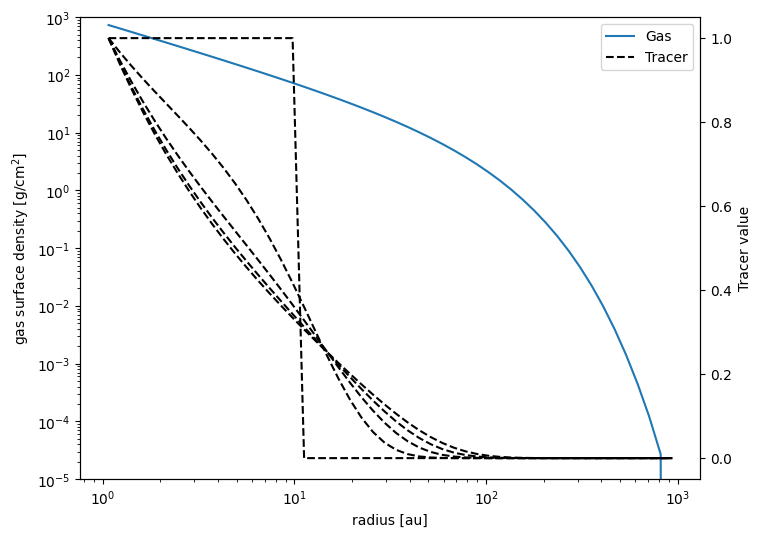
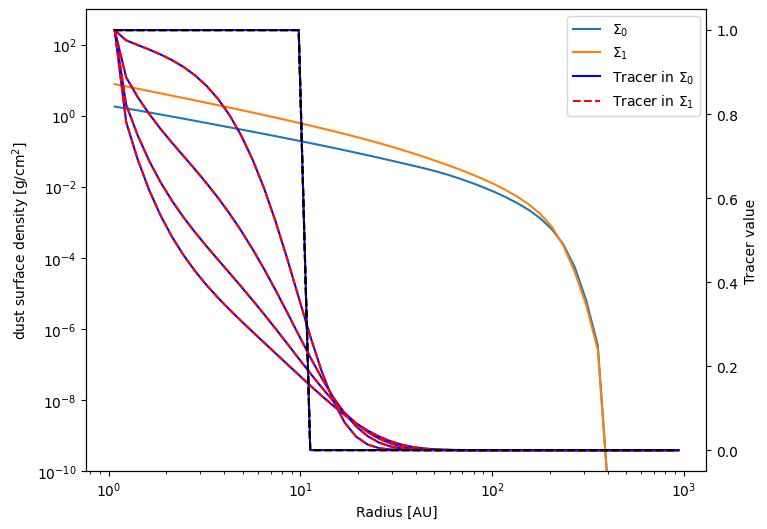
And component of dust is evolved using the density bins of the small dust in lst_tr_dust[i][:,0] and the large dust lst_tr_dust[i][:,1].
[8]:
plt.figure(figsize=(8,6))
plt.plot(sim.grid.r/c.au, sim.dust.Sigma[:,0], label=r"$\Sigma_0$")
plt.plot(sim.grid.r/c.au, sim.dust.Sigma[:,1], label=r"$\Sigma_1$")
plt.plot([],[],'b',label=r'Tracer in $\Sigma_0$')
plt.plot([],[],'r--',label=r'Tracer in $\Sigma_1$')
plt.legend()

plt.yscale("log")
plt.xscale("log")
plt.xlabel('Radius [AU]')
plt.ylabel(r'dust surface density [g/cm$^2$]')
plt.ylim(1e-10, 1e3)
ax2 = plt.twinx()
ax2.set_ylabel('Tracer value')

for t in range(len(data.t))[::4]:
    ax2.plot(sim.grid.r/c.au, data.components.tr_dust.dust.value[t,:,0],"b" )
    ax2.plot(sim.grid.r/c.au, data.components.tr_dust.dust.value[t,:,1],"r--")

plt.plot(sim.grid.r/c.au,tr_dust,'k--',label='Initial condition')
plt.show()
Dust component
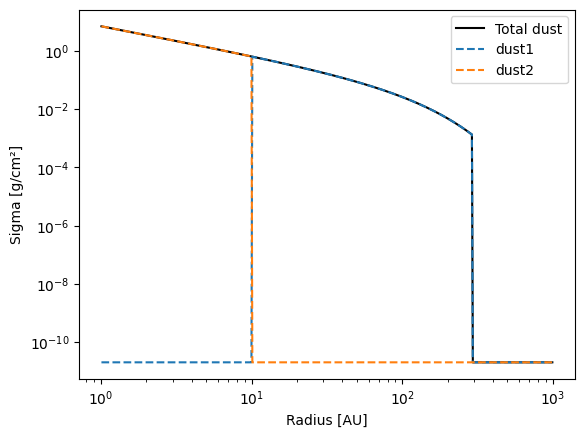
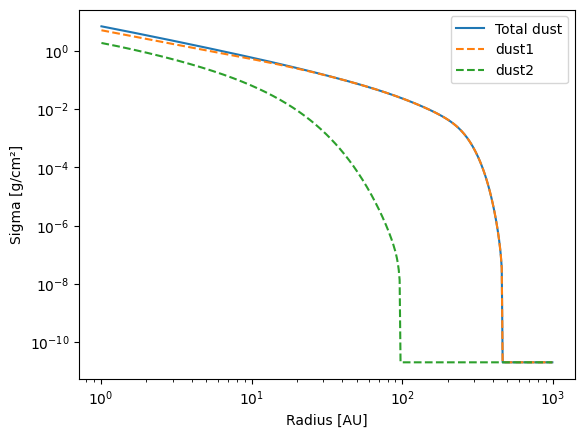
Here, we demostrate how two different dust components will diffuse and mix, while not changing the dust profile. We assuming a separate outer dust reservoir dust_value1 and outer reservoir dust_value2.
[9]:
sim = tripodpy.Simulation()
sim.ini.grid.rmin = 1 * c.au
sim.ini.grid.rmax = 1000 * c.au
sim.ini.grid.Nr = 500
sim.ini.gas.SigmaRc = 100*c.au
sim.initialize()
sim.t.snapshots = np.linspace(0,1e6*c.year,20)

dust_value1 = sim.dust.Sigma.copy()
dust_value1[sim.grid.r<10*c.au] = 1e-11
dust_value2 = sim.dust.Sigma.copy()
dust_value2[sim.grid.r>10*c.au] = 1e-11
sim.addcomponent("dust1",sim.gas.SigmaFloor,1,dust_value=dust_value1 ,dust_active=True, gas_active=False, gas_tracer=False,rhos=sim.dust.rhos[0,0])
sim.addcomponent("dust2",sim.gas.SigmaFloor,1,dust_value=dust_value2 ,dust_active=True, gas_active=False, gas_tracer=False,rhos=sim.dust.rhos[0,0])

sim.writer.datadir = "5.2_data"
This is the initial dust profile. The overall dust follows a smooth profile that needs to be maintained.
[10]:
plt.figure()
plt.plot(sim.grid.r/c.au,sim.dust.Sigma.sum(-1),"k",label="Total dust")
plt.plot(sim.grid.r/c.au,sim.components.dust1.dust.Sigma.sum(-1),"--",label="dust1")
plt.plot(sim.grid.r/c.au,sim.components.dust2.dust.Sigma.sum(-1),"--",label="dust2")
plt.xscale("log")
plt.yscale("log")
plt.xlabel("Radius [AU]")
plt.ylabel("Sigma [g/cm²]")
plt.legend()
plt.show()
[11]:
sim.run()
tripodpy v1.0.0

Creating data directory 5.2_data.
Writing file 5.2_data/data0000.hdf5
Writing dump file 5.2_data/frame.dmp
Writing file 5.2_data/data0001.hdf5
Writing dump file 5.2_data/frame.dmp
Writing file 5.2_data/data0002.hdf5
Writing dump file 5.2_data/frame.dmp
Writing file 5.2_data/data0003.hdf5
Writing dump file 5.2_data/frame.dmp
Writing file 5.2_data/data0004.hdf5
Writing dump file 5.2_data/frame.dmp
Writing file 5.2_data/data0005.hdf5
Writing dump file 5.2_data/frame.dmp
Writing file 5.2_data/data0006.hdf5
Writing dump file 5.2_data/frame.dmp
Writing file 5.2_data/data0007.hdf5
Writing dump file 5.2_data/frame.dmp
Writing file 5.2_data/data0008.hdf5
Writing dump file 5.2_data/frame.dmp
Writing file 5.2_data/data0009.hdf5
Writing dump file 5.2_data/frame.dmp
Writing file 5.2_data/data0010.hdf5
Writing dump file 5.2_data/frame.dmp
Writing file 5.2_data/data0011.hdf5
Writing dump file 5.2_data/frame.dmp
Writing file 5.2_data/data0012.hdf5
Writing dump file 5.2_data/frame.dmp
Writing file 5.2_data/data0013.hdf5
Writing dump file 5.2_data/frame.dmp
Writing file 5.2_data/data0014.hdf5
Writing dump file 5.2_data/frame.dmp
Writing file 5.2_data/data0015.hdf5
Writing dump file 5.2_data/frame.dmp
Writing file 5.2_data/data0016.hdf5
Writing dump file 5.2_data/frame.dmp
Writing file 5.2_data/data0017.hdf5
Writing dump file 5.2_data/frame.dmp
Writing file 5.2_data/data0018.hdf5
Writing dump file 5.2_data/frame.dmp
Writing file 5.2_data/data0019.hdf5
Writing dump file 5.2_data/frame.dmp
Execution time: 0:02:20
[12]:
plt.figure()
plt.plot(sim.grid.r/c.au,sim.dust.Sigma.sum(-1),label="Total dust")


plt.plot(sim.grid.r/c.au,sim.components.dust1.dust.Sigma.sum(-1),"--" ,label="dust1")
plt.plot(sim.grid.r/c.au,sim.components.dust2.dust.Sigma.sum(-1),"--" ,label="dust2")
plt.xscale("log")
plt.yscale("log")
plt.xlabel("Radius [AU]")
plt.ylabel("Sigma [g/cm²]")
plt.legend()
plt.show()
Evaporating and Condensating Component
If the components track molecules within a protoplanetary disc, the molecular species can transition from solids to gas and visversa through (re)sublimation. If the material is no tracer and active this will be taken into account.
[13]:
sim_compo = tripodpy.Simulation()
sim_compo.ini.grid.rmin = 1 * c.au
sim_compo.ini.grid.rmax = 1000 * c.au
sim_compo.ini.grid.Nr = 500
sim_compo.ini.gas.SigmaRc = 100*c.au
sim_compo.initialize()
sim_compo.t.snapshots = np.linspace(0,1e6*c.year,20)

sim_compo.writer.datadir = "5.3_data"

dust_value=np.minimum(sim_compo.gas.Sigma*5e-3,sim_compo.dust.Sigma.sum(-1))
dust_value =  dust_value[:,None] * 0.5
# Adds bcakground dust
sim_compo.addcomponent("default_dust",sim_compo.gas.SigmaFloor,1,dust_value=sim_compo.dust.Sigma ,dust_active=True, gas_active=False, gas_tracer=False,rhos=sim_compo.dust.rhos[0,0])
#add the CO component
sim_compo.addcomponent("CO",sim_compo.gas.SigmaFloor,1,dust_value=dust_value ,dust_active=True, gas_active=True,rhos=1.)
For the sublimation the component requires additional information for each species (or the code will not work): the mean molecular weight sim.components.SPECIES.gas.pars.mu, the attempt frequency sim.components.SPECIES.gas.pars.nu, and the binding energy in Kelvin sim.components.SPECIES.gas.pars.Tsub (see also appendix in https://arxiv.org/pdf/2407.03199) and the bulk density of the material sim.components.SPECIES.dust.pars.rhos.
[14]:
# Set CO parameters for condensation/evaporation
sim_compo.components.CO.gas.pars.mu = 28 * c.m_p
sim_compo.components.CO.gas.pars.nu = 7.0e11
sim_compo.components.CO.gas.pars.Tsub = 1180
sim_compo.components.CO.dust.pars.rhos = 1.0

#update dust internal density -> changed when adding new component
sim_compo.dust.rhos.update()
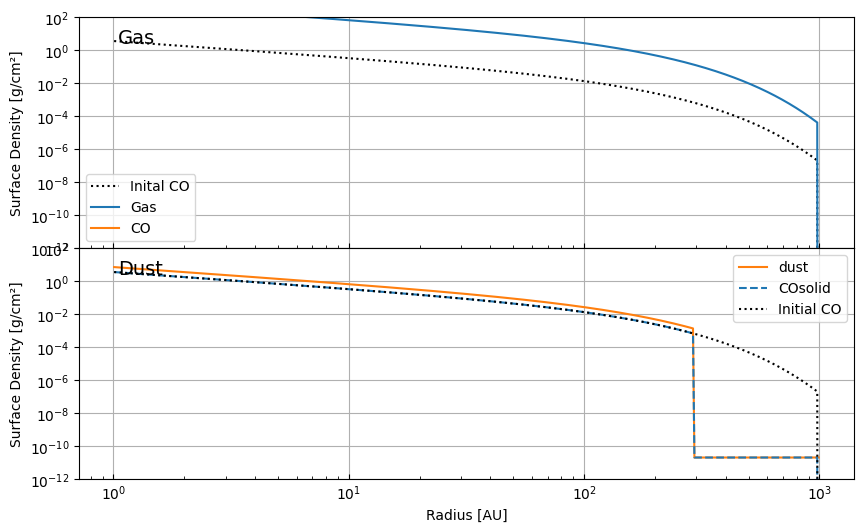
Now in the initial profile, all the CO is initialized as part of the dust component.
[15]:
fg,axs = plt.subplots(2, 1, figsize=(10, 6), sharex=True)
axs[0].plot(sim_compo.grid.r/c.au,sim_compo.gas.Sigma*5e-3,"k:", label="Inital CO")

axs[0].plot(sim_compo.grid.r/c.au,sim_compo.components.Default.gas.Sigma,label="Gas")
p = axs[0].plot(sim_compo.grid.r/c.au,sim_compo.components.CO.gas.Sigma,label="CO")

axs[1].plot(sim_compo.grid.r/c.au, sim_compo.components.default_dust.dust.Sigma.sum(-1),color =p[0].get_color(),label="dust")
axs[1].plot(sim_compo.grid.r/c.au, sim_compo.components.CO.dust.Sigma.sum(-1),"--",label="COsolid")


axs[1].plot(sim_compo.grid.r/c.au,sim_compo.gas.Sigma*5e-3,"k:",label='Initial CO')
axs[0].legend()
axs[1].legend()
plt.subplots_adjust(hspace=0)
axs[0].tick_params(axis='x', direction='in')
axs[1].tick_params(axis='x', direction='in')
axs[0].tick_params(axis='x', which='minor', direction='in')
axs[1].tick_params(axis='x', which='minor', direction='in')
axs[0].text(0.05, 0.95, 'Gas', transform=axs[0].transAxes, fontsize=14, verticalalignment='top')
axs[1].text(0.05, 0.95, 'Dust', transform=axs[1].transAxes, fontsize=14, verticalalignment='top')
for ax in axs:
    ax.set_xlabel('Radius [AU]')
    ax.set_ylabel('Surface Density [g/cm²]')
    ax.set_yscale('log')
    ax.set_xscale('log')
    ax.set_ylim(1e-12, 1e2)
    ax.grid()
plt.show()
[16]:
sim_compo.run()
tripodpy v1.0.0

Creating data directory 5.3_data.
Writing file 5.3_data/data0000.hdf5
Writing dump file 5.3_data/frame.dmp
Writing file 5.3_data/data0001.hdf5
Writing dump file 5.3_data/frame.dmp
Writing file 5.3_data/data0002.hdf5
Writing dump file 5.3_data/frame.dmp
Writing file 5.3_data/data0003.hdf5
Writing dump file 5.3_data/frame.dmp
Writing file 5.3_data/data0004.hdf5
Writing dump file 5.3_data/frame.dmp
Writing file 5.3_data/data0005.hdf5
Writing dump file 5.3_data/frame.dmp
Writing file 5.3_data/data0006.hdf5
Writing dump file 5.3_data/frame.dmp
Writing file 5.3_data/data0007.hdf5
Writing dump file 5.3_data/frame.dmp
Writing file 5.3_data/data0008.hdf5
Writing dump file 5.3_data/frame.dmp
Writing file 5.3_data/data0009.hdf5
Writing dump file 5.3_data/frame.dmp
Writing file 5.3_data/data0010.hdf5
Writing dump file 5.3_data/frame.dmp
Writing file 5.3_data/data0011.hdf5
Writing dump file 5.3_data/frame.dmp
Writing file 5.3_data/data0012.hdf5
Writing dump file 5.3_data/frame.dmp
Writing file 5.3_data/data0013.hdf5
Writing dump file 5.3_data/frame.dmp
Writing file 5.3_data/data0014.hdf5
Writing dump file 5.3_data/frame.dmp
Writing file 5.3_data/data0015.hdf5
Writing dump file 5.3_data/frame.dmp
Writing file 5.3_data/data0016.hdf5
Writing dump file 5.3_data/frame.dmp
Writing file 5.3_data/data0017.hdf5
Writing dump file 5.3_data/frame.dmp
Writing file 5.3_data/data0018.hdf5
Writing dump file 5.3_data/frame.dmp
Writing file 5.3_data/data0019.hdf5
Writing dump file 5.3_data/frame.dmp
Execution time: 0:03:04
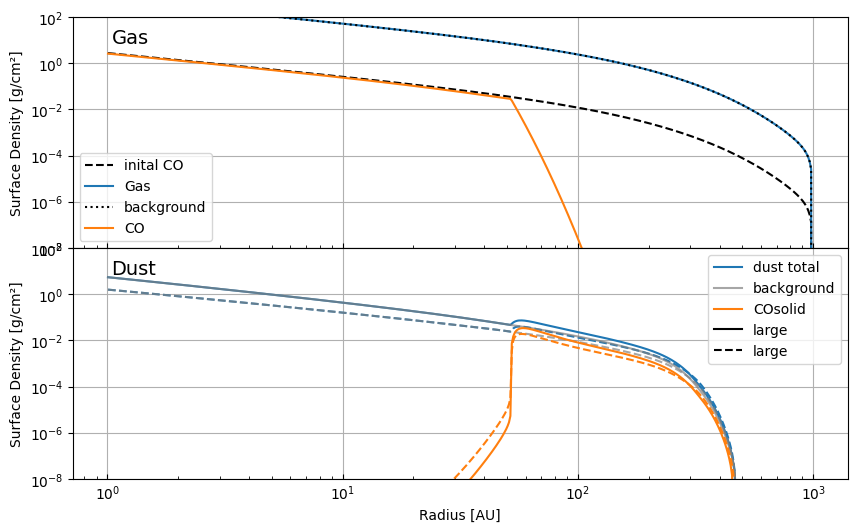
In the simulation the CO will find new equilibrium between condensation and sublimation of the molecular species (CO here). This means if will the gas density will drop exponentially at the ice line, while the dust density is reshaped by the drift, back-diffusion and sublimation to a more complexe profile.
[17]:
fg,axs = plt.subplots(2, 1, figsize=(10, 6), sharex=True)
axs[0].plot(sim_compo.grid.r/c.au,sim_compo.gas.Sigma*5e-3,"k--", label="inital CO")

p1 = axs[0].plot(sim_compo.grid.r/c.au,sim_compo.gas.Sigma,label="Gas")
axs[0].plot(sim_compo.grid.r/c.au,sim_compo.components.Default.gas.Sigma,"k:",label="background")
p = axs[0].plot(sim_compo.grid.r/c.au,sim_compo.components.CO.gas.Sigma,label="CO")

axs[1].plot(sim_compo.grid.r/c.au, sim_compo.dust.Sigma[:,0],"--",color =p1[0].get_color())
axs[1].plot(sim_compo.grid.r/c.au, sim_compo.dust.Sigma[:,1],color =p1[0].get_color(),label="dust total")

axs[1].plot(sim_compo.grid.r/c.au, sim_compo.components.default_dust.dust.Sigma[:,0],"--",color ="gray", alpha =0.7)
axs[1].plot(sim_compo.grid.r/c.au, sim_compo.components.default_dust.dust.Sigma[:,1],color ="gray", alpha =0.7,label="background")

axs[1].plot(sim_compo.grid.r/c.au, sim_compo.components.CO.dust.Sigma[:,0],"--",color =p[0].get_color())
axs[1].plot(sim_compo.grid.r/c.au, sim_compo.components.CO.dust.Sigma[:,1],color =p[0].get_color(),label="COsolid")

axs[1].plot([],[], label='large', color="k")
axs[1].plot([],[], "k--",label='large')
axs[0].legend()
axs[1].legend()
plt.subplots_adjust(hspace=0)
axs[0].tick_params(axis='x', direction='in')
axs[1].tick_params(axis='x', direction='in')
axs[0].tick_params(axis='x', which='minor', direction='in')
axs[1].tick_params(axis='x', which='minor', direction='in')
axs[0].text(0.05, 0.95, 'Gas', transform=axs[0].transAxes, fontsize=14, verticalalignment='top')
axs[1].text(0.05, 0.95, 'Dust', transform=axs[1].transAxes, fontsize=14, verticalalignment='top')
for ax in axs:
    ax.set_xlabel('Radius [AU]')
    ax.set_ylabel('Surface Density [g/cm²]')
    ax.set_yscale('log')
    ax.set_xscale('log')
    ax.set_ylim(1e-8, 1e2)
    ax.grid()
plt.show()
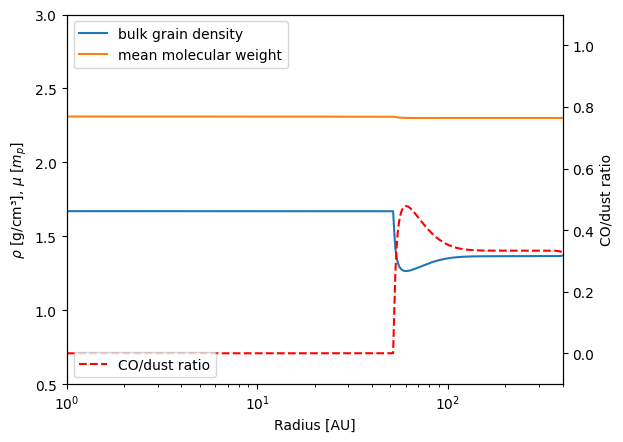
The evolution of the chemical component shifts the bulk grain density and the mean molecular weight in the gas self consistently.
[18]:
plt.figure()
plt.plot(sim_compo.grid.r/c.au,sim_compo.dust.rhos[:,1],label="bulk grain density")
plt.plot(sim_compo.grid.r/c.au,sim_compo.gas.mu/c.m_p,label="mean molecular weight")
plt.xscale("log")
plt.ylabel(r"$\rho$ [g/cm³], $\mu$ [$m_p$]")
plt.xlabel("Radius [AU]")
plt.ylim(0.5,3)
plt.legend(loc= "upper left")
ax = plt.gca()
ax2 = ax.twinx()
ax2.plot(sim_compo.grid.r/c.au,sim_compo.components.CO.dust.Sigma.sum(-1)/sim_compo.dust.Sigma.sum(-1),"--",color="r",label="CO/dust ratio")
plt.ylabel("CO/dust ratio")
plt.ylim(-0.1,1.1)
plt.xlim(1,400)
plt.legend(loc="lower left")
plt.show()
Common pitfalls setting up simulations using components
When setting up a simulation with components, there are some common pitfalls to be aware of:
for condensating/evaporating components, truncate the initial distribution at the same location as the dust disk
for each component
compyou can check if it’s active in the gas or dust by checkingcomp.gas_activeandcomp.dust._activeremember that the code always works in cgs units, so initialze the components accordingly (especially \(\mu\))
remember to initalize the relevant parameters for evaporation and condensation for hybrid components,
if using dust components, remember to add a “background component” as the field
sim.dust.Sigmawill be overwritten by the sum of the dust/gas components, i.e.comp.gas.pars.nuandcomp.gas.pars.TsubRemember that the gas disk always has one default component called
Defaultthat is only active in the gas and models the total evolution (if no other components are present)when using components, external source terms are defined on the component level, i.e. set
comp.gas.Sigma_dotandcomp.dust..Sigma_dotfor external source termsremember tracer components can only have the “val” boundary condition